
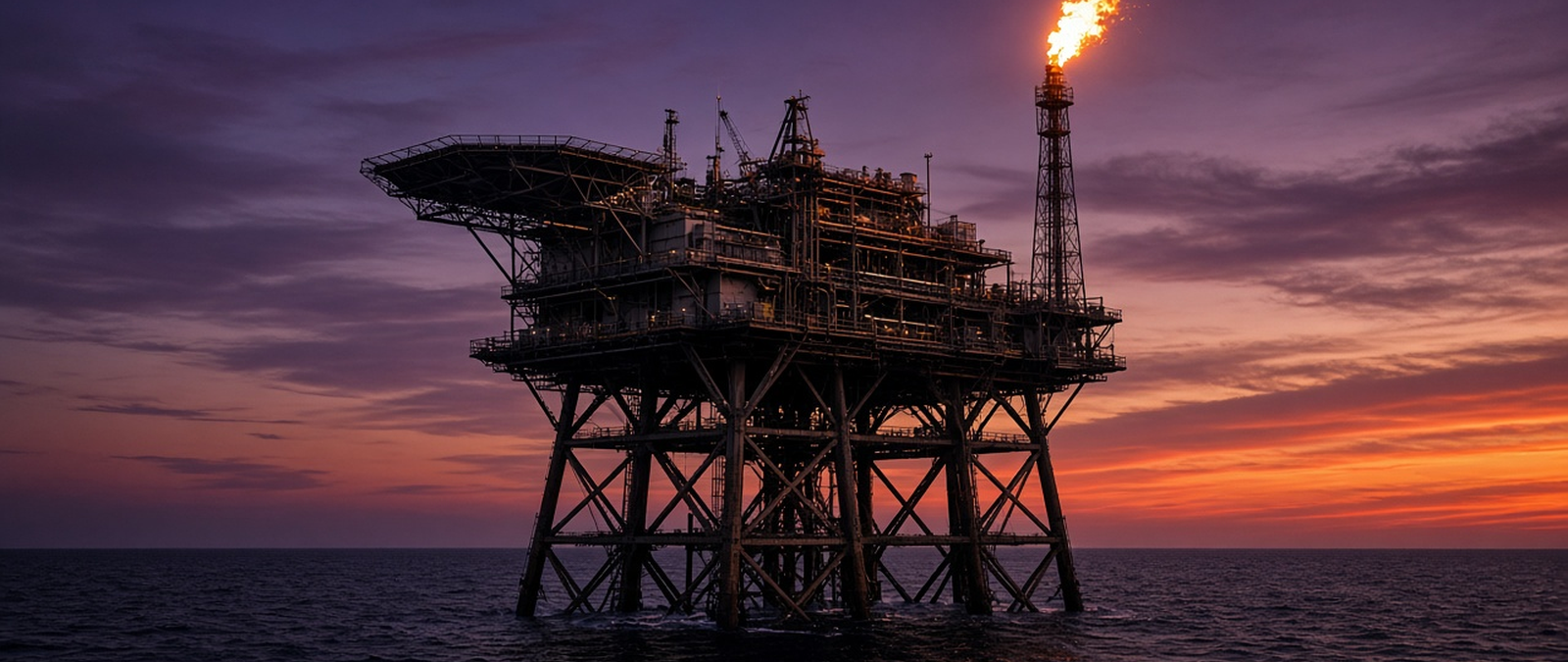
A drilling rig sank off Gabon with five workers still missing, and Malaysia’s prime minister said SoftBank’s founder plans $50 billion of technology investment in his country. Saudi Arabia intends to store crude oil in Singapore’s underground caverns, Jeep India added an automatic gearbox to its cheapest Compass, and bitcoin dropped below $80,000 again.
Five workers missing after a Borr Drilling rig sinks off Gabon
Five offshore workers remained unaccounted for after the Prospector 5, a jack-up rig, became unstable and went down off Gabon late on Saturday, its owner, Borr Drilling, said. According to the company, the incident happened at about 20:37 local time on 24 October, while the rig was being jacked up ahead of a planned campaign for BW Energy at the Dussafu licence. Of the 115 people on board, 110 have been accounted for, both companies said, and search and rescue work is continuing.
Borr Drilling said preliminary information showed the rig had suffered a punch-through during preload work, which led to the loss of stability and the sinking. Its chief executive, Bruno Morand, said the company was deeply concerned for those still missing and that its priority was the search and the welfare of everyone involved. BW Energy said output at its MaBoMo facility had been halted as standard practice during the drilling preparations, and that the facility had suffered no damage and released nothing harmful into the sea.
The Prospector 5, built in 2014, is a self-elevating unit designed to operate in water up to 400 feet deep and to drill as far as 35,000 feet. Jack-up rigs are buoyant hulls with movable legs that are lowered to the seabed; in a step known as preloading, the weight of the hull and ballast water push the legs firmly into the bottom. Gabon is the fifth-largest oil producer in Africa, and the oil sector accounts for 50% of its GDP and 80% of its exports.
SoftBank’s Son plans $50 billion of technology investment in Malaysia
SoftBank Group founder Masayoshi Son has picked sites in Malaysia for technology investments worth US$50 billion, Prime Minister Anwar Ibrahim said on Saturday. Speaking in Melaka, Anwar said Son had told him during a video conference earlier in the week that he had chosen Kuching, in Sarawak, and peninsular Malaysia for projects in artificial intelligence, new technology and data centres, describing them as among the largest investments in the region. SoftBank did not immediately respond to a request for comment.
Anwar said the investment would bring new and better jobs, particularly for younger workers, and that Malaysia’s appeal to investors depended on confidence in the government and on political stability. The Malaysian Investment Development Authority says the country attracted 385.7 billion ringgit of data-centre investment from 2021 to the first half of 2026, from companies including Amazon, Microsoft and Google. Malaysia aims to become an AI nation by 2030, and SoftBank signed framework agreements earlier this month to explore AI infrastructure in Sarawak.
SoftBank is a Japanese investment holding company based in Tokyo, founded in 1981 and led by Son, who is also its largest shareholder. Its Vision Fund, launched with more than $100 billion and backed by Saudi Arabia’s Public Investment Fund, is the largest technology-focused venture capital fund in the world. In January 2025 the group joined OpenAI, MGX and Oracle in Stargate, a US infrastructure project for artificial intelligence estimated at $500 billion, and it is building data centres in Japan and planning another project in France.
Saudi Arabia to store crude oil in Singapore’s underground caverns
Saudi Arabia plans to keep crude oil in the Jurong Rock Caverns, Singapore’s underground storage site, from the second half of 2027, Tan See Leng, the city-state’s minister for energy, trade and industry, said on Monday. Speaking at the Singapore International Energy Week conference, Tan said both countries were declaring their joint intent to set up the arrangement, which he said would make the Saudi crude supply chain in Southeast Asia more resilient.
The minister said the deal would also add to Singapore’s energy security and help the country cope with any disruption to supplies. According to Tan, Saudi Aramco was due to sign a memorandum of understanding on Monday with the Energy Market Authority and JTC Corporation, the government body that owns the caverns, and the parties hope to finish negotiations within a few months. No details were given of the volumes of oil to be stored or of the commercial terms of the arrangement.
The caverns, the first underground rock facility for oil storage in Southeast Asia, were opened on 2 September 2014 by Lee Hsien Loong, then prime minister. They lie 130 metres beneath Banyan Basin on Jurong Island and serve companies on the island such as Shell and ExxonMobil, holding liquids including crude oil, condensate, naphtha and gas oil. The first phase cost SGD 950 million and offers 1,470,000 cubic metres of storage, and a second phase is set to double capacity to 2.8 million cubic metres.
Jeep India adds an automatic gearbox to the entry-level Compass
Jeep India on Monday launched the Compass Sport FWD with a nine-speed automatic transmission, priced at ₹21.99 lakh ex-showroom. The company said the new version is the most affordable automatic Compass in the country and, for the first time, offers an automatic option on the SUV’s entry-level trim. It is powered by a 2.0-litre turbo diesel engine producing 170 HP and 350 Nm of torque, driving the front wheels, and is aimed at buyers who want an automatic for everyday use.
Kumar Priyesh, business head and director for automotive brands at Stellantis India, said the new gearbox made the Compass driving experience more accessible than ever. The variant has six airbags, cruise control, an auto hold function and a 21.3 cm touchscreen with wireless smartphone connection, along with electrically adjustable mirrors. An optional pack priced at ₹29,900 adds ambient lighting, a dashcam, floor mats and mud flaps. Deliveries are due to start in the second week of November 2026 through Jeep dealers and Stellantis outlets.
The Compass is a compact crossover SUV that Jeep introduced in 2006 for the 2007 model year. It was unveiled in India on 12 April 2017 and has been assembled since then at the Fiat India Automobiles plant in Ranjangaon, near Pune, which Stellantis runs jointly with Tata Motors. The Indian factory is the only one that builds the right-hand-drive version, which is exported to markets including the United Kingdom, Australia, Japan and South Africa. The third generation of the model made its debut in May 2025.
Bitcoin slips below $80,000 as tension with Iran weighs on markets
Bitcoin fell below $80,000 again over the weekend, briefly reaching $79,973 before buyers lifted it back to $80,287. The move came a day after a steeper drop, when the cryptocurrency sank to $79,220 on the Binance exchange and touched a weekly low of $79,107, its weakest level in more than a month. Bitcoin has lost 3.3% so far in October but is still 26.8% higher than it was 90 days ago, and the $80,000 mark matters to its largest holders.
The fall came amid concern over Iran, after President Donald Trump suggested at a Florida rally on 23 October that tensions could rise again after the midterm elections. Oil prices also fed worries about inflation, with West Texas Intermediate crude reaching $107.89 a barrel on 20 October. US spot bitcoin exchange-traded funds recorded a net outflow of $635.5 million on 22 October, the largest since June. Data from Glassnode puts the next major support at $77,600 if the price cannot recover $81,500.
Bitcoin, the first decentralised cryptocurrency, was devised in 2008 by an unknown person using the name Satoshi Nakamoto and came into use in 2009. Transactions are recorded on a public ledger known as the blockchain and validated through an energy-intensive process called mining. New coins are issued until 21 million exist, a point expected around the year 2140. In January 2024 the first 11 US spot bitcoin exchange-traded funds began trading, giving investors direct exposure to bitcoin on American stock exchanges.