
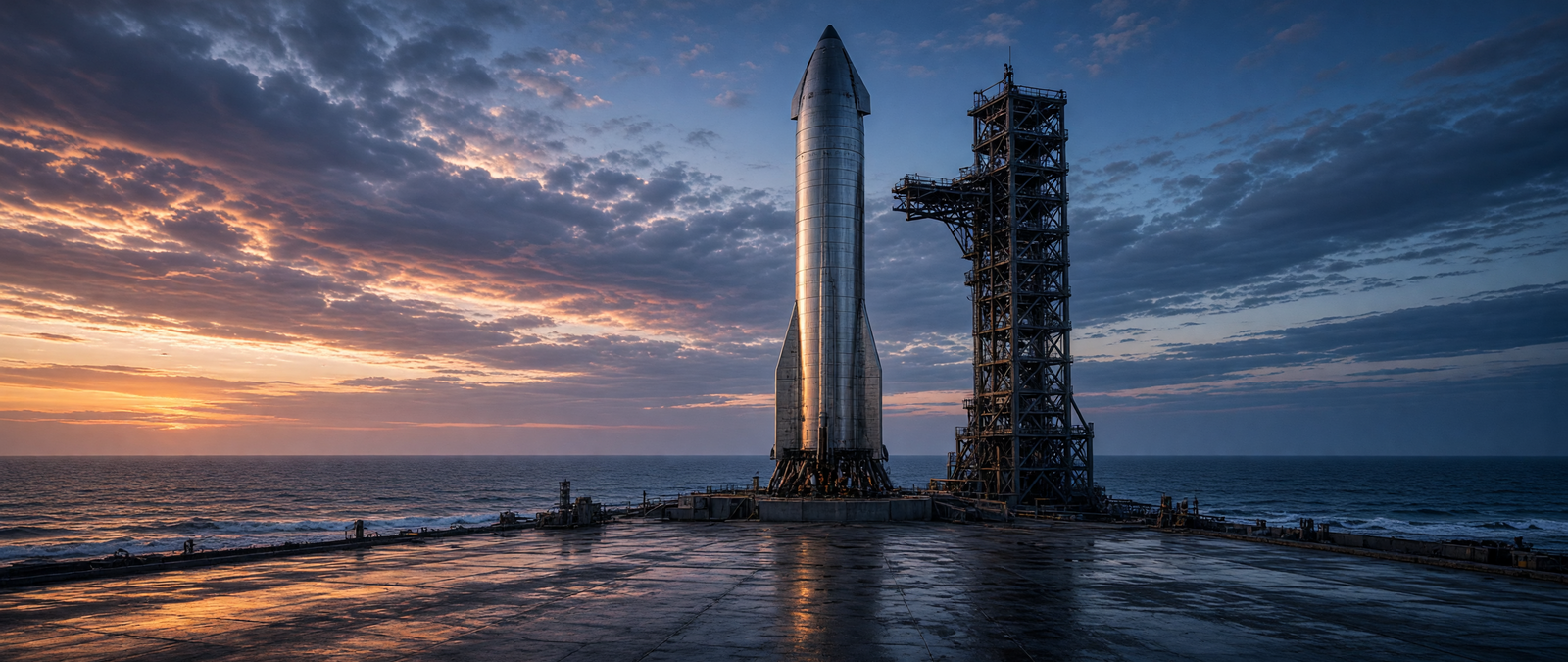
SpaceX won US approval for a vast network of orbital data-centre satellites, Washington detailed new tariffs on 14 trading partners, Elon Musk pledged SpaceX shares to every American child, a FedEx cargo jet overran a Miami runway on the eve of Thanksgiving, and JD Vance said Nvidia’s Jensen Huang needs no pardon.
US regulator clears SpaceX to put up to one million Starmind satellites in orbit
The US Federal Communications Commission has given SpaceX conditional approval to place up to one million Starmind satellites in orbit, designed to work as data centres in space, the first authorisation of its kind in the United States. Commission chairman Brendan Carr said on Wednesday that the decision opened a new frontier for the computing infrastructure needed to sustain American growth and leadership. Elon Musk, who founded and runs SpaceX, called the approval a great asset to America and the world.
SpaceX plans to launch the first Starmind satellites in the third quarter of 2027 on its fully reusable Starship rocket, the company has said. Under the licence, it has until late 2033 to put the first operational satellite into service, until 2035 to reach 100,000 and until 2040 to complete the network. The solar-powered units would process data in orbit and send the results to Earth through optical links. Blue Origin, Google and Starcloud are among other companies pursuing similar projects.
SpaceX already runs Starlink, the largest satellite network ever built, with about 11,150 spacecraft in low Earth orbit as of October 2026 and broadband service in about 160 countries and territories. Starlink became the company’s largest business in 2025, generating $11.4 billion in revenue. Since the start of the space age in 1957, about 28,000 satellites have been launched in total, and astronomers have criticised large constellations for adding to light pollution and to the risk of collisions in orbit.
Washington sets out tariffs of up to 20 per cent on 14 trading partners
The US trade representative has set out the new tariffs on 14 major trading partners that Washington had been preparing over what it calls excess industrial capacity. The duties cover goods from China, the European Union, Japan, South Korea, India, Indonesia, Taiwan, Switzerland, Singapore, Malaysia, Thailand, Vietnam, Bangladesh and Cambodia, a US official said. China faces a new 20 per cent levy that lifts the total on some of its goods to 45 per cent, and Vietnam also faces 20 per cent.
Rates for the other partners range from 10 to 18 per cent, and many will be capped at lower levels under deals already struck with the administration. Brazil, whose trade negotiations with Washington have stalled, faces a separate 10 per cent duty on aircraft exports, which affects the planemaker Embraer, and higher duties on raw and refined sugar. Australia is not on the list. China has rejected accusations of overcapacity, saying its exports reflect competitive advantages.
The measures rest on an investigation under Section 301 of the Trade Act of 1974, a law that gave the president broad powers to counter unfair foreign trade practices. In February the Supreme Court struck down the emergency tariffs Donald Trump had imposed by declaring two national emergencies, though duties based on other laws stayed in place. Republicans lost ground in the recent midterm elections, and a poll after the vote found that 62 per cent of respondents would support repealing the tariffs.
Musk pledges two SpaceX shares to every child in the United States
Elon Musk has pledged that each American child will get two SpaceX shares, with the company and Musk himself each providing one, a gift worth almost $18bn at Wednesday’s closing price of $127.44. SpaceX said it would issue one new Class A share to every active Trump Account, the investment accounts created for American children, and that Musk would match its donation. Gwynne Shotwell, the company’s president, said she would also donate more than 2 million of her own shares.
Musk said the company’s shares would be transferred next month, while his own would follow when his lockup period expires in June next year. SpaceX said ownership of the company should extend to the next generation of Americans. Its shares fell as much as 9% during Wednesday’s session before closing 1.30% higher, still below the June listing price of $135. The Treasury Department said contributions to the accounts from friends and relatives had passed $1 billion.
Trump Accounts were authorised by the 2025 One Big Beautiful Bill Act and opened for deposits on 4 July 2026; the money cannot be withdrawn before the year the child turns 18. The federal government offers a $1,000 deposit for children born from 2025 to 2028, and the White House said last month that almost 70 million accounts had been opened. Musk first promised in October to give one of his own shares to every American child.
FedEx cargo jet overruns a Miami runway and halts flights before Thanksgiving
A FedEx McDonnell Douglas MD-11 cargo plane ran off runway 26R at Miami International Airport on Wednesday evening, prompting the Federal Aviation Administration to halt flights bound for Miami on the eve of Thanksgiving, when air travel in the US is at one of its yearly peaks. The Miami-Dade Sheriff’s Office said it reached the aircraft at about 8:40 pm and that neither of the two people on board was hurt. Fire crews found no sign of fire or smoke.
All runways except one were closed, and departures heading to Miami were held for about 90 minutes before flights resumed, with delays of around an hour. FedEx said Flight 910 from Memphis had experienced an issue on landing and that its crew was safe. Rain had cut visibility at the airfield, where a 13 mph tailwind was reported, and an airport worker said the crew appeared unable to slow the jet on the wet surface. The FAA has opened an investigation.
The MD-11 is the largest three-engine jet ever built; only 200 were produced before production ended in October 2000, and many passenger versions were converted into freighters. The FAA grounded the type in November 2025 after a UPS MD-11 crashed in Louisville, Kentucky, and UPS retired its whole fleet in January 2026. FedEx, which flew 26 of the aircraft at that time, had said it planned to keep operating them until 2032.
Vance says reinstated Nvidia chief Jensen Huang needs no pardon
US Vice-President JD Vance said on Wednesday that Jensen Huang, who was reinstated this week as Nvidia’s chief executive, had never been under criminal investigation and did not need a pardon. His remarks came a day after President Donald Trump said in an interview that a pardon for Huang was always an option, though he did not think it would be necessary. Vance said he backed the reinstatement after receiving assurances from the attorney general and other senior officials.
Attorney General Todd Blanche said on Tuesday that no evidence showed Huang had committed a crime, but he did not say whether the Justice Department had carried out a full investigation. Lawmakers from both parties have asked which officials advised the Nvidia board that Huang’s return posed no security risk. Republican senators John Curtis and Pete Ricketts and Democrats Elizabeth Warren and Elissa Slotkin all raised questions, and Huang is expected to testify before congressional committees in the coming weeks.
Huang, a co-founder of Nvidia, briefly gave up his posts at the company this year after reports that he had had affairs outside his marriage, one of them with a woman who was at first suspected of spying for China. The board voted unanimously on 23 November to reinstate him as president, chief executive and a director, after pressure from the White House. Trump appointed Huang earlier in 2026 to his council of science and technology advisers. Congress also wants answers on Nvidia’s chip exports and on chips that remain unaccounted for.