
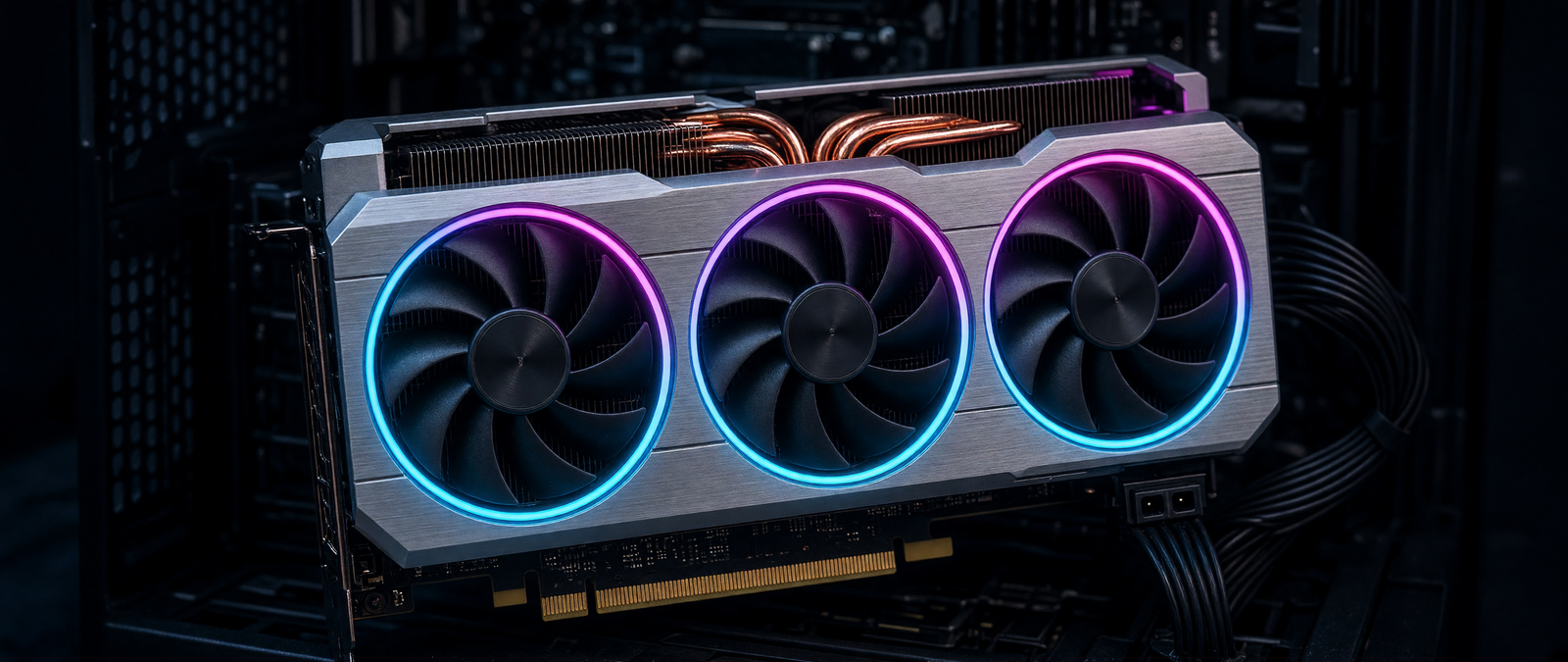
A developer has released tools that let Nvidia RTX owners run modified graphics card firmware without flashing it, and the PA has agreed to buy Australia’s RAS Technology. Google AI agents have beaten Minecraft, RTX 5090 cards worth $470,000 have vanished at a Brazilian airport, and a fake WhatsApp app has passed 500,000 downloads.
New tools let Nvidia RTX owners run modified graphics card firmware without flashing it
A developer known as Panchovix has released three tools that let owners of Nvidia GeForce RTX 50, 40 and 30 series cards run a modified VBIOS, the firmware that controls a graphics card, without writing anything to the card’s flash chip. The editor, for Windows and Linux, can change power limits, voltage ceilings, over-current limits, fan channels and the ranges of core and memory clock offsets. Edited files carry a signature that no longer matches, so they cannot be flashed in the usual way.
On Windows, the loader keeps the edited image in the driver’s registry key, and the driver applies it each time the card starts; on Linux, it patches Nvidia’s open kernel modules instead. In the developer’s own tests, the power limit of an RTX 5090 was raised to 800 W and that of an RTX 5080 from 360 W to 500 W. Laptop RTX 40 chips cannot be edited yet, and memory timings stay unchanged. Both loaders are open source, while the editor is offered as closed-source binaries.
Raising power and voltage limits can cause instability and overheating, and users are advised to keep a copy of their original firmware. Nvidia has not commented publicly on the tools. In August it used a driver update to block mVolt+, another tool that unlocked power limits on RTX 50 cards, and the new Windows loader needs driver version 616.56 or later. Nvidia lists the total graphics power of its own RTX 5090 Founders Edition at 575 W, a different figure from the board power ceiling the editor changes.
The PA agrees to buy Australian racing data firm RAS Technology for A$49.8 million
The PA, the group behind the UK’s Press Association news agency, has agreed to buy RAS Technology Holdings, the company listed on the Australian Securities Exchange that owns the racing data and wagering technology supplier Racing and Sports. The all-cash deal values RAS at about A$49.8 million, roughly £26 million. The PA is offering A$1.04 a share, a 93% premium to the closing price of A$0.54 on 16 October, and RAS shares rose by about 85% after the announcement.
The takeover will be carried out through a court-approved scheme of arrangement and is expected to be completed in February 2027, subject to a shareholder vote and the approval of Australia’s Federal Court. The RAS board has unanimously backed it, and the co-founders Gary Crispe and Robert Vilkaitis, who together hold or control about 34% of the shares, intend to vote in favour. Emily Shelley, chief executive of the PA, said the combined business would offer customers more data and cover more markets.
Racing and Sports will sit alongside Podium, the PA’s racing and sports betting data business, which supplies data, content and technology to bookmakers, broadcasters and rights holders and has worked in racing for more than 40 years. RAS was founded in 1999 and floated on the exchange in 2021 at A$1.50 a share, above the price now on offer. The two businesses will operate separately until the deal is completed, and the purchase would take the PA into the Australian wagering market.
Four Google Gemini AI agents beat Minecraft without human help
Four AI agents running on Google’s Gemini 4 Argon model have defeated the Ender Dragon, the final boss in Minecraft, without human help, Google DeepMind researchers said in a paper. The run took 27 hours and 14 minutes from the agents’ first program. They began in a randomly generated survival world on Easy difficulty with cheats switched off, and were given only the goal of beating the dragon, with no roles, strategy or tools written for the game.
The agents never saw the screen. Each controlled a player by writing short programs, and between them they wrote 2,783 programs, exchanged 229 chat messages and died 605 times. They divided the work among themselves, with one making tools and finding the stronghold, another gathering food, a third lighting a portal and a fourth landing the final blow. The fight in the End took nearly 14 hours, and the whole session cost about $810 at an introductory list price.
The agents controlled their players through Mineflayer, an open-source JavaScript library for building Minecraft bots that can query the blocks around them, track creatures, manage inventories and use chat. The researchers list limits: the library tells the agents exactly what is nearby, even behind solid rock, a plugin planned their routes, more than a fifth of their programs failed with errors, and the finding rests on one run. A fifth agent watched the session for cheating and found none.
Two pallets of RTX 5090 graphics cards go missing at São Paulo’s main airport
Oderço, a Brazilian hardware distributor, says two pallets of Zotac GeForce RTX 5090 graphics cards have disappeared at São Paulo/Guarulhos International Airport. The company puts the loss at R$2.5 million, about $470,000, which is its purchase cost rather than the retail value. The cards reportedly reached the airport but could not be found afterwards, and the distributor has not said how many cards were on the pallets or which models were included.
Oderço Matos, president of the company, which is based in Maringá, published a video on 16 October explaining the case. He said the business had operated for 38 years and had imported hardware since 2008 without ever losing a shipment, and that repeated requests for information had gone unanswered. He also questioned the lack of security camera footage of the cargo, saying two pallets do not vanish by themselves inside an international airport.
The RTX 5090 is Nvidia’s top consumer graphics card and has been in short supply worldwide, disappearing from many online retailers in the middle of September. There have been reports that Nvidia stopped making it to focus on more expensive professional AI cards, which the company has denied. In Brazil, single cards sell for about R$33,000 to R$39,000. Costly components have become targets for crime before, from stolen home deliveries to cards returned to sellers with their key parts removed.
Fake WhatsApp app passes 500,000 downloads on Google Play
A counterfeit WhatsApp app has been installed more than half a million times from the Google Play Store. The listing, created last month by a developer account called Agment Assets sallu that offers nothing else, uses a description and screenshots close to those of the real app. Users have reported that it sometimes appears in sponsored search results when people look for the genuine WhatsApp, although in many searches the real app still ranks first.
The listing uses Google Play’s Early Access programme, and apps in Early Access do not show public user reviews, which makes it harder to tell a genuine app from a copy. The security company Bitdefender had earlier warned about this weakness. The fake app had stayed on the store for more than a month, and the reports do not explain what it does with users’ data. The genuine app has passed 10 billion installs on Google Play.
The case follows a counterfeit copy of Google Chrome on the same store, which was downloaded more than 100,000 times before it was taken down a few days earlier. The WhatsApp copy first drew attention in a Reddit forum devoted to small everyday annoyances. Reports differ on whether Google has since removed it: a Spanish-language security account said on 18 October that it had, while reports published on 19 October said the listing was still available.